
Sep 30, 2026
LA/Long Beach Friction Eases to Flowing, Truck PTI Below Normal
LA/Long Beach's friction read is back to Flowing after last week's Some Pressure read. The BTS truck PTI fell to 2.26, below its trailing-12-month normal of 4.07. All three major complexes are now Flowing.
Numbers as of Sep 30, 2026 pull
Cite
Get the weekly port brief
Get The Dwell in your inbox every Tuesday. No spam, we won't ever share your email, and you can always unsubscribe.
LA/Long Beach's import-friction read returned to Flowing this week, after last issue's Some Pressure read. The BTS truck planning-time index at the complex sits at 2.26, well below its trailing-12-month normal of 4.07. Ships awaiting berth at LA/Long Beach eased to 2 ships, down 33% week over week and near the trailing-12-month normal of 1 ship, per MARAD and the Marine Exchange.
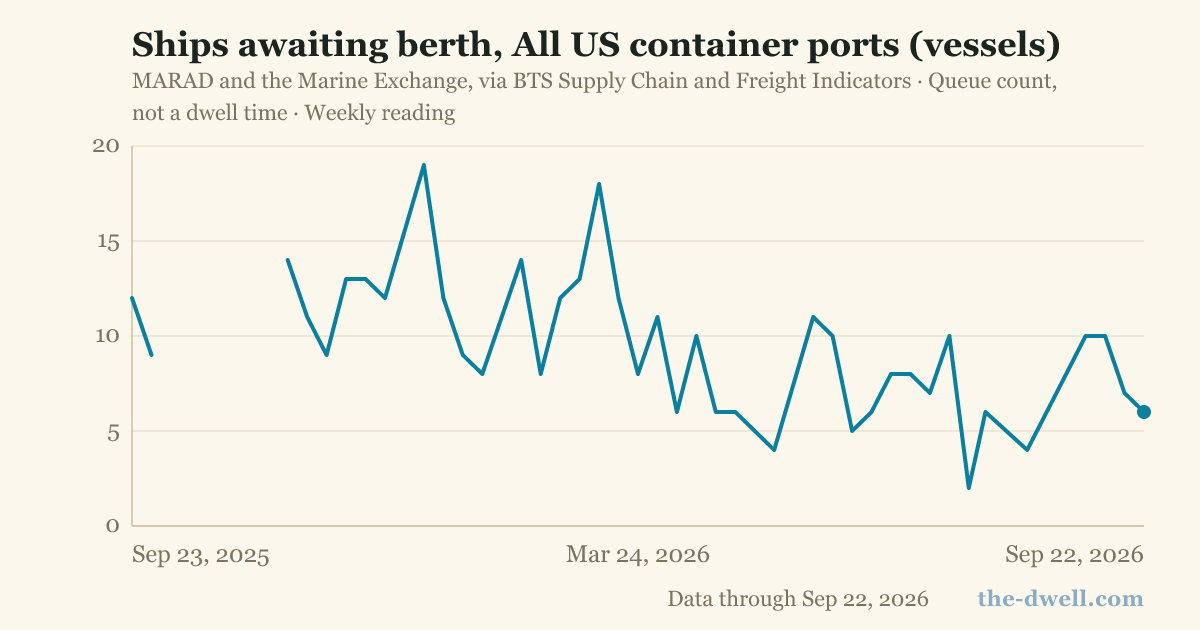
- All-US ships awaiting berth: 6 ships (MARAD), down 14% week over week, and 75% below the five-year median.
- Savannah ships awaiting berth: 2 ships (MARAD and the Marine Exchange): doubled week over week, 82% below the five-year median, near trailing-12-month normal of 2 ships. Friction read: Flowing.
- Gulf Coast ships at anchor: 0 (MARAD), 100% below the five-year median.
- NY/NJ friction read: Flowing. BTS truck PTI at 2.23, below trailing-12-month normal of 3.82. Loaded imports 392,074 TEU, near normal of 382,286 TEU, per port authority monthly data.
- Port of Long Beach UP rail cars dwelling nine or more days: 397, up 230.8% week over week from 120 per Port of Long Beach data. BNSF nine-plus-day cars fell 13.5% to 2,868 over the same period.
The Port of Los Angeles reported 955,907 TEU in August 2026, on par with August 2025 and 6% above the port's five-year average for the month, per the port authority's Sep 9, 2026 release. The port described the June-August stretch as the busiest three consecutive months in its history. The LA/Long Beach complex logged 967,013 TEU in loaded imports for August, near the trailing-12-month normal of 848,128 TEU per port authority monthly data.
Monthly loaded-import figures reflect August 2026, published in September; they are the latest available, not the current week's volume.